September 18, 2026 · InnerVoice Team
The Annual Survey Trap: Why 80-Question Pulse Checks Kill Workplace Candor
Why annual employee engagement surveys fail to surface genuine workplace truth, and how continuous, anonymous feedback loops build real organizational agility.
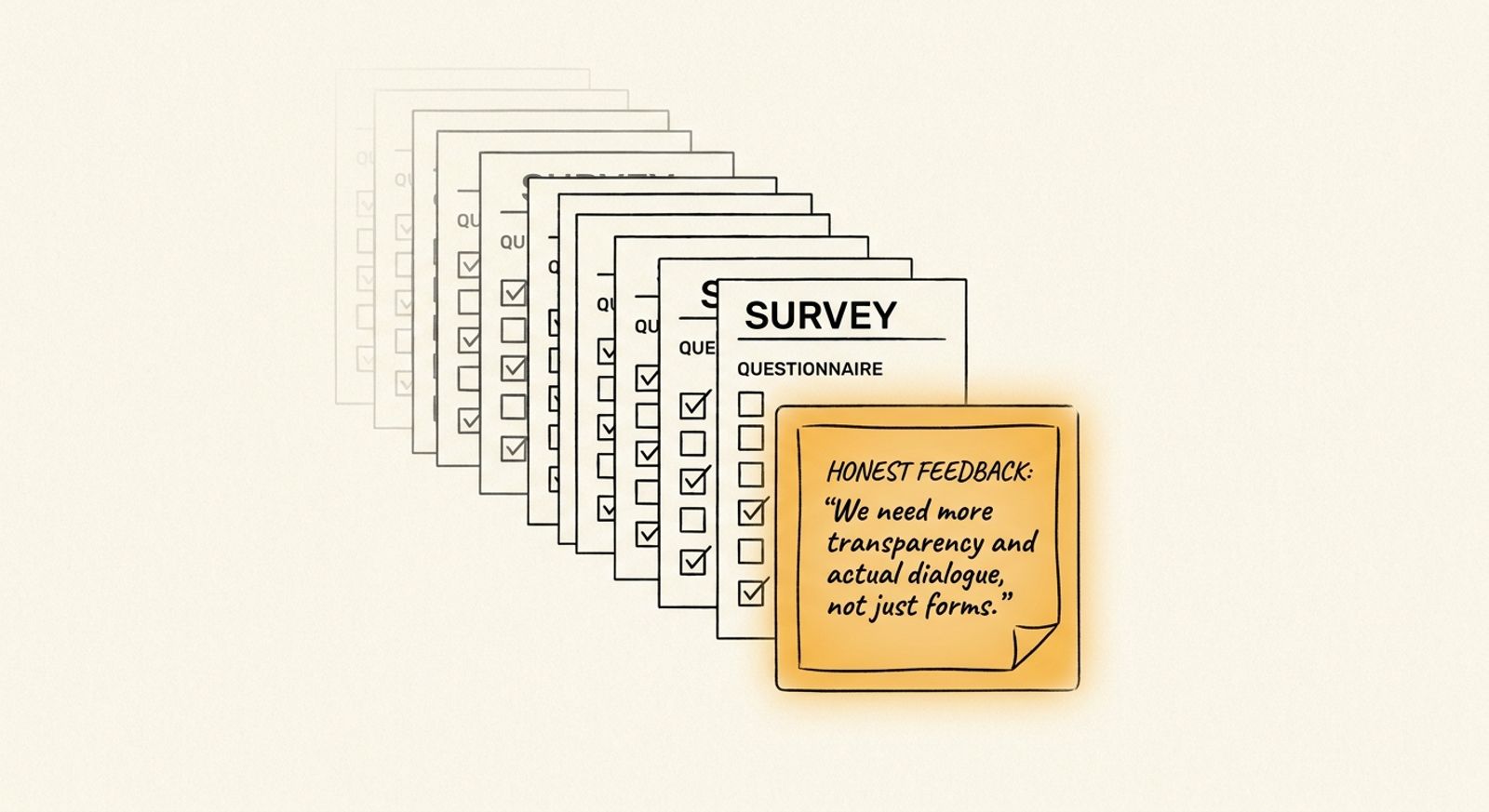
Every autumn, corporate inboxes around the world are inundated with the same dreaded notification: "It's time for our Annual Employee Engagement Survey!" What follows is usually an exhausting, 80-question gauntlet of Likert scales asking employees to rate everything from executive vision to cafeteria coffee on a scale of 1 to 5.
Leadership teams genuinely believe these massive yearly pulse checks demonstrate care. In reality, they do the exact opposite: they treat workplace sentiment like an annual compliance audit rather than a living, breathing conversation.
The Latency Problem: Solving Q1 Frustrations in Q4
The most fatal flaw of the annual survey is latency. When an engineer experiences burnout in February, or a product team hits a severe cross-functional roadblock in April, an annual survey administered in October is hopelessly obsolete.
By the time HR aggregates the dataset, filters department breakdowns, prepares executive decks, and schedules an all-hands debrief in December, the employees who voiced the original concerns have often already updated their LinkedIn profiles and handed in their two weeks' notice. Feedback delayed is feedback discarded.
Why 80 Questions Breed Employee Cynicism
When surveys take 30 minutes to complete, cognitive fatigue takes over after question ten. Employees stop answering thoughtfully and start clicking middle-of-the-road ratings just to finish. Worse, large monolithic surveys trigger severe trust issues:
- The 'Anonymous' Demographic Trap: When a survey asks for department, tenure, seniority, and location, members of small teams realize leadership can easily deduce who wrote what. True honesty disappears.
- The Black Hole Effect: Staff pour their hearts into long comment boxes, only to never hear a single acknowledgment or see tangible action taken on the specific issues raised.
- Event Fatigue: Turning culture into a high-stakes annual spectacle creates unnatural stress for managers and performative theater for executives.
The Shift to Continuous, Always-On Listening
Modern, high-performing organizations are retiring the monolithic annual survey in favor of lightweight, continuous listening loops. Instead of forcing employees to wait nine months to voice a suggestion, they maintain permanent digital suggestion boxes where feedback can be submitted the moment friction occurs.
Continuous listening changes the psychological contract between staff and leadership. When submitting a suggestion takes 30 seconds without requiring a login or answering 79 unrelated questions, participation skyrockets—and the feedback reflects real-time operational reality rather than retrospective frustration.
Visible Accountability: The Power of Public Team Walls
The missing ingredient in most feedback systems isn't the collection mechanism—it's the acknowledgment loop. When feedback goes into a private spreadsheet seen only by HR, employees assume nothing happened.
Curating selected suggestions onto a transparent team wall, paired with written public responses from leadership, completely transforms company culture. Even if the answer to a request is 'No, not right now because of budget priorities,' employees respect the candor. When teams see that honest feedback is addressed openly, psychological safety flourishes.
Hear what your team won't say out loud.
Set up an anonymous suggestion box in under 60 seconds. Free forever.
Start free